Olympias Patras B.C.: a history worth keeping
Olympias Patras B.C., also encountered as Olympiada Patras and AEP Olympiada Patron, belongs to the basketball history of Patras in western Greece. Its top-division seasons and FIBA archive provide firm starting points for understanding the club without turning an incomplete record into an invented biography.

Start with the identity, not a borrowed crest
Names are the first challenge in researching this club. Greek names can appear in several English transliterations, and an archive may shorten a name that another source writes in full. Search results for Olympias, Olympiada and AEP therefore need to be compared carefully. A matching city is useful evidence, but the competition, season and opponent should also agree before two entries are treated as the same team.
There is another distinction that matters just as much: a basketball department and a wider sporting association are not automatically interchangeable subjects. A date attached to a parent association does not, by itself, establish when a particular team began playing organized basketball. This guide avoids assigning an unsupported founding date to the basketball department. It also makes no claim to represent the club or any successor organization.
The domestic record gives the story a frame
Basketball-Reference lists Olympias Patras in the Greek top division for 2006–07 and 2007–08. Those entries anchor the club's elite domestic period in identifiable seasons. They are more useful than a vague claim that the team once played at the highest level because readers can return to the underlying season tables and compare like with like. [1]
A league appearance tells us where a team competed. It does not explain its finances, internal decisions or the experiences of its supporters. Those subjects require different evidence, such as contemporary reporting or documented interviews. Nor should two seasons become a substitute for the entire history of basketball around the club. The record is a doorway into a larger story, rather than permission to fill every gap with a confident narrative.
A European chapter, accurately named
FIBA maintains a historical team entry for Olympias Patras in its 2007 EuroCup Challenge archive. That is the competition label used here. European tournament names can be deceptively similar, and later summaries sometimes compress distinct competitions into the same familiar term. Returning to the organizer's archive helps avoid confusing this event with a different European cup. [2]
The distinction is important even when discussing a relatively small piece of club history. Qualification rounds, group stages and separate tournaments are not interchangeable achievements. A careful article identifies the organizer and edition before describing participation. Readers investigating individual games should use the archive's game records and preserve the dates shown there, rather than infer a schedule from a season mentioned on another website.
Read a season as a sequence of decisions
A historical table is easier to understand when its categories are separated. Regular-season results describe one phase of a competition; playoff outcomes describe another. A change in division belongs to the following season's context. Mixing these into a single sentence can make a modest campaign sound like a title challenge or conceal the actual competitive level.
For your own research, begin a worksheet with columns for season, competition, source and the exact fact being recorded. Keep an empty cell when a fact is unresolved. This simple method is preferable to copying a complete-looking timeline from an unsourced summary. It also makes future corrections precise: changing a competition label need not disturb a separately verified domestic entry. A transparent record can grow without pretending it was complete from the beginning.
Why Patras changes the perspective
The club's story becomes more interesting when viewed through its city. Patras basketball is not reducible to one institution, one building or one successful period. Different clubs can share a civic audience while retaining separate identities. The history of Olympias should therefore sit alongside, rather than absorb, the histories of other Patras teams.
For a visitor, that means a contemporary game in Patras can offer useful basketball context without being presented as an Olympias fixture. A present-day team's colors, supporters and ticketing arrangements belong to that team. Our guide to basketball in Patras explores this distinction in more detail. Treating local basketball as an ecosystem makes room for both prominent clubs and less documented community activity, without manufacturing a direct institutional connection between them. The wider city story is explored in our guide to basketball in Patras.
Buildings are evidence only when the connection is documented
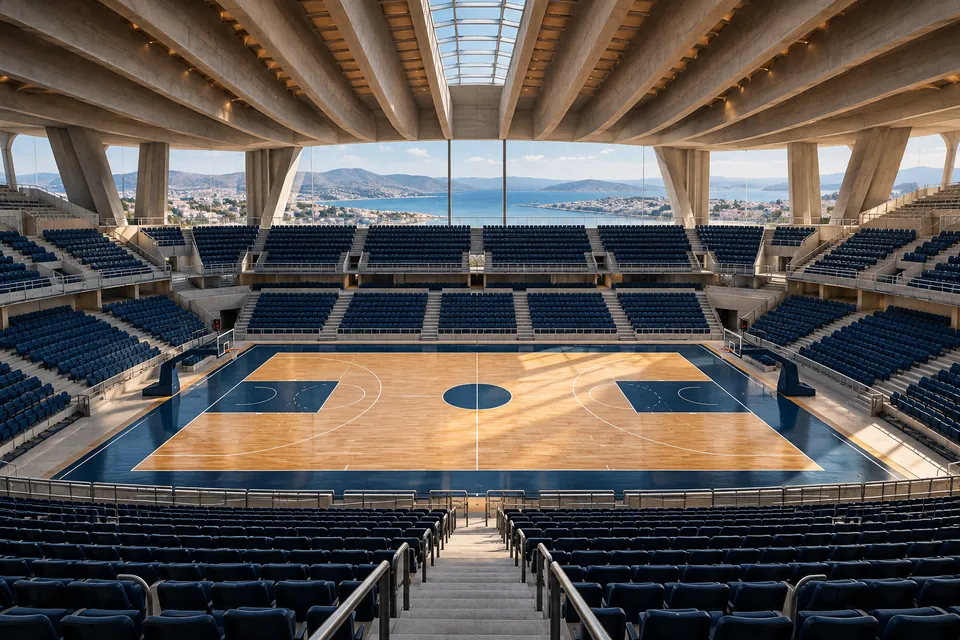
A photograph of a basketball hall can establish what that building looked like at a particular moment. It cannot prove that a named club used it in an unspecified season. Venue histories need their own sourcing, especially when a team has trained in one place and staged senior fixtures elsewhere. Capacity figures may also depend on seating configuration.
That is why the artwork accompanying this article is openly illustrative. It evokes a gym setting but does not depict a verified Olympias facility, player or match. If you hold an old program or photograph, preserve the reverse side, handwritten notes and original filename as well as the main image. These details may identify the date and venue more reliably than the visual subject alone. Permission to reproduce an item should be checked separately from its historical value. Our Patras arena guide separates venue research from matchday planning.
A legacy can be discussed without inventing testimony
The most responsible way to describe the club's legacy is to explain what survives in accessible records and why preserving it matters. Domestic and European entries place Olympias within a wider sporting network. They give future researchers something concrete to investigate, even when personal accounts or local documents remain unavailable.
Avoid attributing emotions to an entire city or writing imagined scenes of a decisive night. Such scenes can be powerful in fiction, but they are misleading when presented as history. A more durable publication distinguishes documented events, editorial interpretation and unanswered questions. Readers can then appreciate the club's place in Greek basketball without being asked to trust a fictional witness. Continue with our league-history guide for competition terminology, or the Patras venue guide for a separate account of planning a basketball visit. Read the Greek basketball competition guide to interpret those records.
A few useful answers
Is this the official Olympias Patras website?
No. This is an independent historical and editorial publication, with no claimed club affiliation.
Which European archive should I consult?
FIBA's 2007 EuroCup Challenge team archive identifies Olympias Patras. Preserve that competition label when citing it.
Sources & further verification
Sources checked for this edition on 22 October 2026. Historical records and live announcements serve different purposes.
Olympias Club Editorial
Independent historical basketball and sports-culture coverage. No claimed club affiliation or individual professional credentials.
Read our editorial policy →